Our History
The Montgomery began life as the Cedars, the plantation home of David Montgomery. It is one of the few antebellum houses still standing in Oktibbeha County, and it stayed in the Montgomery family for more than 160 years. The people who lived here helped shape Starkville itself, from the dairy farms that once defined the county to the college that became Mississippi State University.
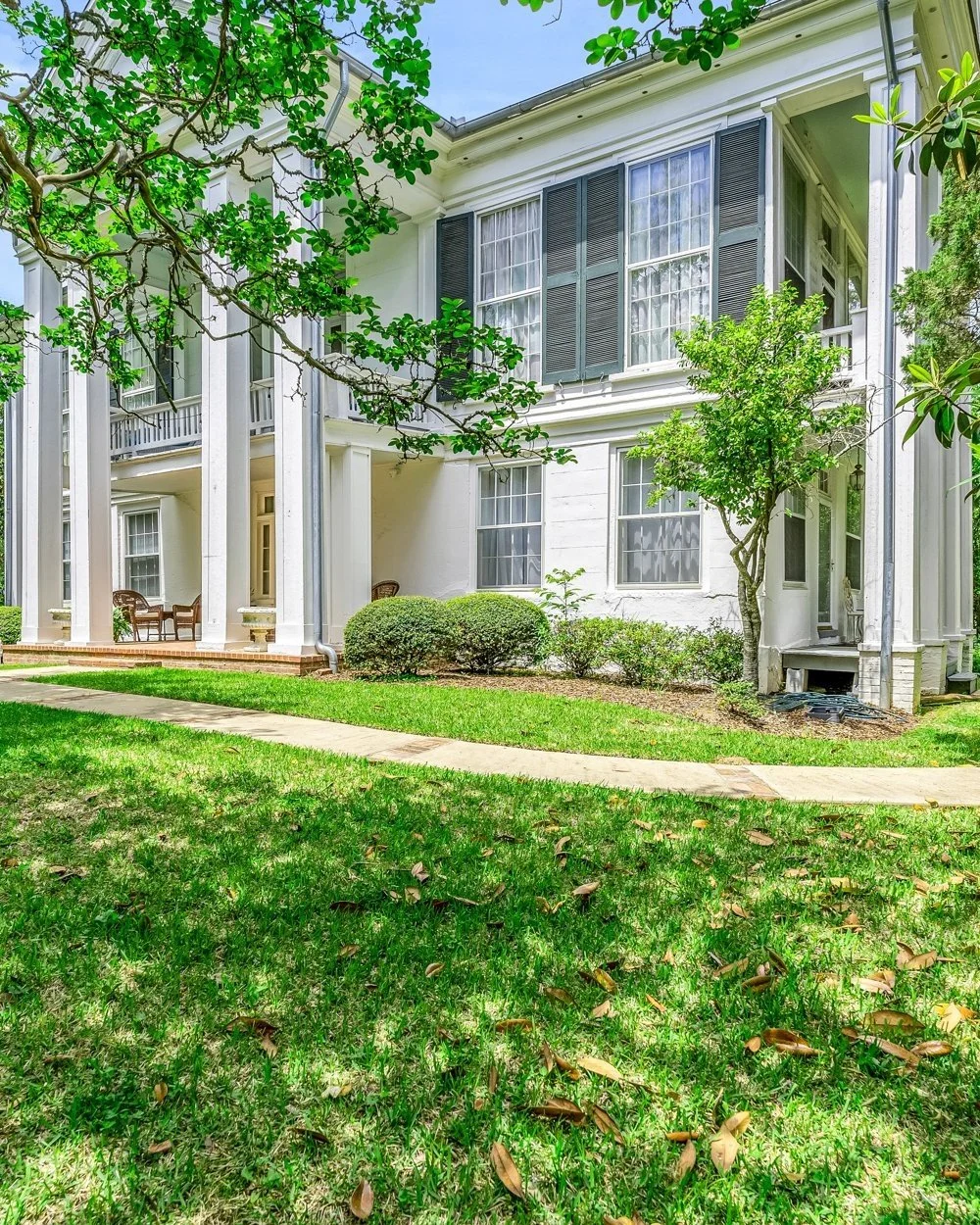
The Cedars
David Montgomery, the second son of an Irish immigrant, came to the Starkville area in 1837 already a man of some means. A planter and member of the state legislature, he established a cotton plantation in the rolling hills of Oktibbeha County and built his home, the Cedars, between 1837 and 1840. Its bricks were made on the plantation, and the house was built largely by enslaved people. Their labor is part of this house's story, and we tell it plainly.
A raised cottage
The Cedars is a two-story Greek Revival house built on the raised-cottage plan, with its main living floor upstairs. The form began on the Gulf Coast, where French and Spanish builders of the 1700s lifted living spaces off the ground to catch the breeze and stay above floodwaters. Here it was enlarged and given classical columns to suit a Mississippi planter. The house is framed in walnut on a foundation of logs. The lower story is brick, stuccoed and scored to look like cut stone, and the upper story is wood frame and clapboard. Three two-story porticoes, each with four columns, a pediment and a balcony, face south, east and west. It is the only raised-cottage plantation house left in Oktibbeha County.
What survives inside
Downstairs, a central hall and stair open onto parlors about 20 feet square, with wide pine floors, original iron and brass door hardware and an unusual wave-pattern valance over every window. The mantels are folk takes on classical designs; the finest, in the front parlor, has slender reeded columns. At the back of the house is the old spinning room, where cloth was made, its original beams still exposed. Upstairs, under 12½-foot ceilings, two rooms open into each other through wide sliding doors to form a ballroom, with arched niches on either side of the fireplace and doors painted to look like wood grain.
Ten days in 1864
In February 1864, Confederate General James R. Chalmers made the Cedars his headquarters for ten days while coordinating with General Nathan Bedford Forrest in Columbus to keep Union troops from Memphis from joining General William T. Sherman at Meridian. Local lore says Chalmers also found time during his stay to write a song in praise of "the pretty little girls of Starkville."
Colonel W.B. Montgomery
No one who lived at the Cedars left a bigger mark on Starkville than David Montgomery's nephew, Colonel William Bell Montgomery. Born in South Carolina in 1829, he came to Oktibbeha County as a boy of six, graduated from the College of New Jersey (now Princeton) in 1850 and worked as a cotton broker in Mobile. In 1865 he came home to farm, and the Cedars passed to him on his uncle's death. For more than three decades he was the leading agricultural voice in north Mississippi.
The dairy capital of the South
Seeing that cotton had worn out the soil around Starkville, W.B. planted pasture grasses, imported Jersey cattle from the Isle of Jersey, the first in Mississippi, and started the area's first dairy here on the plantation. One of the house's old porches was even enclosed as a cream separating room. In 1875 he founded and edited The Livestock Journal, followed by the Southern Livestock Journal, a forerunner of the Progressive Farmer. Neighbors called him crazy until, as one 1931 headline put it, cows dethroned King Cotton: dairying became Oktibbeha County's leading industry, and the county came to be known as the dairy capital of the South. By 1926 the area's dairy farms were strong enough to draw the Borden Company's milk condensery to Starkville, the first south of the Mason-Dixon line. In the first half of the 1900s, more than 800 small dairy farms, most milking Jerseys and Guernseys, earned the county the nickname "Little Wisconsin." It began in the pastures at the Cedars.
Building Starkville
In 1870 W.B. founded the Starkville Female Institute, which the town later took over as a public school. When fire destroyed 52 buildings in Starkville in 1875, he became one of the town's most determined promoters as it rebuilt.
Bringing the college to Starkville
In 1878 Mississippi chose a site for its new land-grant agricultural and mechanical college. As the local story goes, the site committee was all but set on Meridian when W.B. asked a fellow member to vote for Starkville, just so his hometown wouldn't lose 4–1. The final vote was 3–2, for Starkville: he had talked not one colleague but two into switching. Legend or not, he served on the college's first board of trustees and remained its local trustee for 26 years, helping start its dairy and textile courses. That college is now Mississippi State University.
Montgomery Hall
The college later named one of its grandest buildings for him. Built in 1902–03 as the Scientific Building and designed by R.H. Hunt & Company, the Beaux Arts red-brick hall, with an apse designed to hold the college library, was renamed W.B. Montgomery Agricultural Hall. It is one of the oldest and most prominent buildings on the Mississippi State campus, listed on the National Register of Historic Places in 1975 and designated a Mississippi Landmark in 1986. In 2004 the university restored it and rededicated it with Montgomery descendants on hand. Montgomery Street in Starkville carries his name too. W.B. died at Starkville in 1904, and his portrait was hung in the Hall of Fame at the Mississippi State Capitol.
Preserving the house
On October 10, 1985, the Cedars was listed on the National Register of Historic Places, from a nomination prepared by Michael Fazio. The house also appears in A Guide to Early American Homes – South (1956), Old Homes of Mississippi, Volume II: Columbus and the North (1977) and The Majesty of Eastern Mississippi and the Coast (2004). Montgomery descendants lived here until 1999. The house was restored in the years that followed, and in 2019 the Carsons opened it to guests as a bed and breakfast and wedding venue.
The next chapter
In May 2026, lifelong friends Corky Smith and Stephen Johnston became the house's newest stewards. Fittingly, the agent who helped them buy it, Jane Anna Waide, is W.B. Montgomery's great-great-great-granddaughter. They grew up together in Columbus and were roommates at Mississippi State, and Starkville has always felt like a second home. "We think of ourselves as stewards rather than simply owners," they say. "Our responsibility is to honor the home's history, preserve its architectural character, and make thoughtful improvements that allow it to remain a vibrant part of the community for generations to come." As Starkville grows, they believe progress and preservation should go hand in hand, and that every guest becomes a small part of the house's continuing story.
Timeline
1837 · David Montgomery arrives in Oktibbeha County and founds his plantation
1837–1840 · The Cedars is built
1864 · General James R. Chalmers makes the Cedars his headquarters for ten days
1865 · W.B. Montgomery returns home to farm and brings Jersey cattle to Mississippi
1870 · W.B. founds the Starkville Female Institute
1875 · W.B. founds The Livestock Journal
1878 · Mississippi A&M, now Mississippi State, is founded in Starkville, with W.B. on its first board of trustees
1902 · The college's Scientific Building, later renamed W.B. Montgomery Agricultural Hall, is built
1985 · The Cedars is listed on the National Register of Historic Places
2019 · The house opens to guests as a bed and breakfast and wedding venue
2026 · In May, Corky Smith and Stephen Johnston take on the next chapter as stewards of the house
Nearly two centuries on, the Cedars is still a place to gather.
Come be a part of our history! Book your stay →